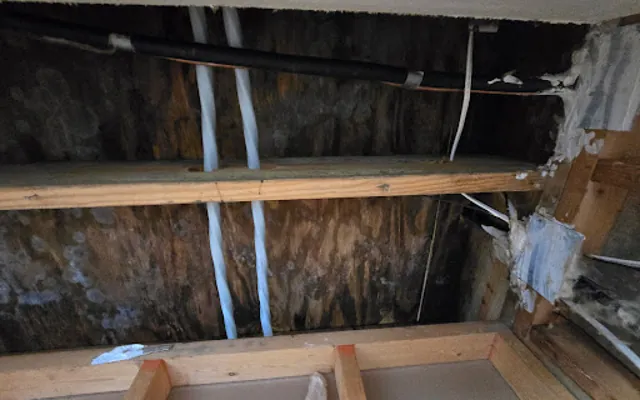
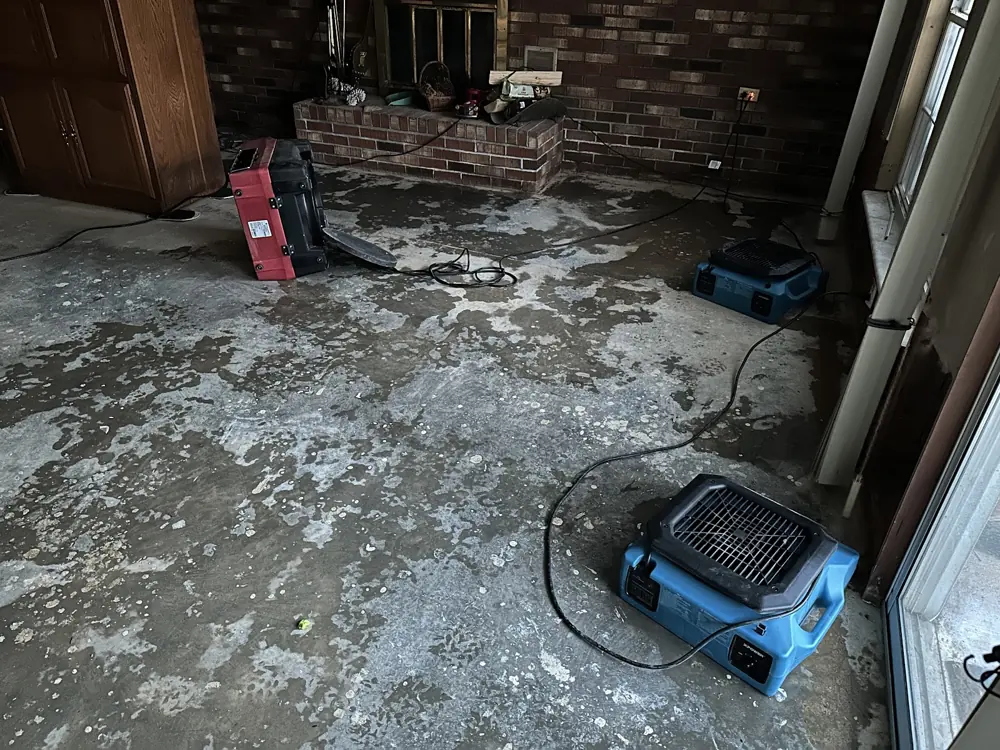
A wind-driven storm opens up flashing and shingles, and the water shows up as a stained, sagging ceiling a room or two away. Crews find the source, dry the structure, and stop the damage from spreading downward.

Crews follow the water back from the stain to the real entry point using moisture meters and thermal imaging.
Standing water is removed and the area is protected so the leak does no further interior damage.
Wet insulation is removed and the attic, ceiling, and wall cavities are dried to a verified target.
Damaged drywall and finishes are restored once dry, with roof repair coordinated to stop the leak.

While help is on the way, these first steps, done only where it is safe, limit the damage and protect the insurance claim.
Shut the supply off at the source, or close the home's main valve if the source is not obvious. Stopping the flow limits the damage more than anything else.
Switch off electricity to the affected area, but only if the breaker can be reached without standing in or touching the water.
Get a crew dispatched right away. The sooner extraction and drying begin, the more flooring, drywall, and belongings can be saved.
Take photos and a short video of the water and the affected rooms before anything is moved, so the insurance claim starts strong.
Roof leak water damage cleanup in Stamford typically runs $1,200 to $5,000, depending on how long the leak ran, how far the water traveled, and how much insulation, drywall, and framing must be dried or replaced. A small, recent leak sits toward the lower end, while a long-running leak that reached multiple ceilings runs higher. The roof repair itself is a separate cost, and sudden storm-driven leaks are usually a covered insurance claim, documented for the carrier.
Crews reach Stamford and lower Fairfield County fast, from Shippan and Glenbrook to Darien, Greenwich, Norwalk, and New Canaan, plus the New York border towns of Port Chester and Rye. See the full list on the areas served across Stamford page.
See all areas servedEvery loss is photographed, measured, and logged from the first visit, so the paperwork holds up with your insurance carrier.
Technicians follow recognized IICRC drying standards and prove the work with daily moisture readings, not guesswork.
Emergency dispatch any hour of the day or night, with a real crew on the way, not a callback in the morning.
A real crew dispatched any hour, not a callback in the morning.
Trained technicians following recognized IICRC drying standards.
Truck-mounted, portable, and submersible for any size loss.
The loss is documented and billed to the carrier directly.
Not usually. Water runs along rafters and framing before it drips, so the roof failure is often several feet away from the stain. Tracing the true source is the first step of the work.
The active leak has to be stopped or temporarily protected so no new water enters, but drying the structure can begin right away. The roof repair is coordinated separately.
Soaked insulation loses its value and holds moisture against the framing, so it is usually removed rather than dried in place, which also lets the structure dry faster.
In a hard Stamford winter, snow melts higher on the roof, refreezes at the cold eaves, and backs meltwater up under the shingles, where it finds its way into the attic and ceilings.
Sudden storm-driven leaks are usually covered, while damage from a roof that was worn out and neglected over time is often excluded. The cause and the interior damage are documented for the claim.
Stamford crews are on call 24 hours a day, local and fast, and can be on the way within the hour.
Call (475) 239-5010